

The Banker Who Found Peace in a Six-Inch Heel
Jaysuits! If your internal monologue is permanently set to “Competitive Pre-Teen Psychological Warfare” after that Dance Nation deep dive, honestly, it’s time for something else entirely. We need a soul detox.
Now, I’ll be honest; after weeks of big spooky Halloween spectacles (especially the chaos down at the The Beaumont) , I wasn’t looking for another show to lose my mind over. I was planning to be sensible. Responsible, even. Maybe watch Netflix and finally conquer that backlog of laundry.
But then, you know how it goes. I fell down a rabbit hole. I was doing my usual deep-dive research, clicking through event listings with the enthusiasm of someone paying Vancouver-rate bills online, when suddenly I stumbled across an interview. Standard stuff. I’m skimming, right?
Then I hear this line from the interviewer, Cathy Holmes from ACT3 Media:
“I have to say my body was just like holy crap your voice is angelic.”
And friends, I have feelings.
And I think, “Sure, sure. Everyone says that about every singer.”
So I find his EP. I press play.
Oh.
Oh no.
Because now I’m that person. The one who immediately texts three friends saying “DROP EVERYTHING AND LISTEN TO THIS.”
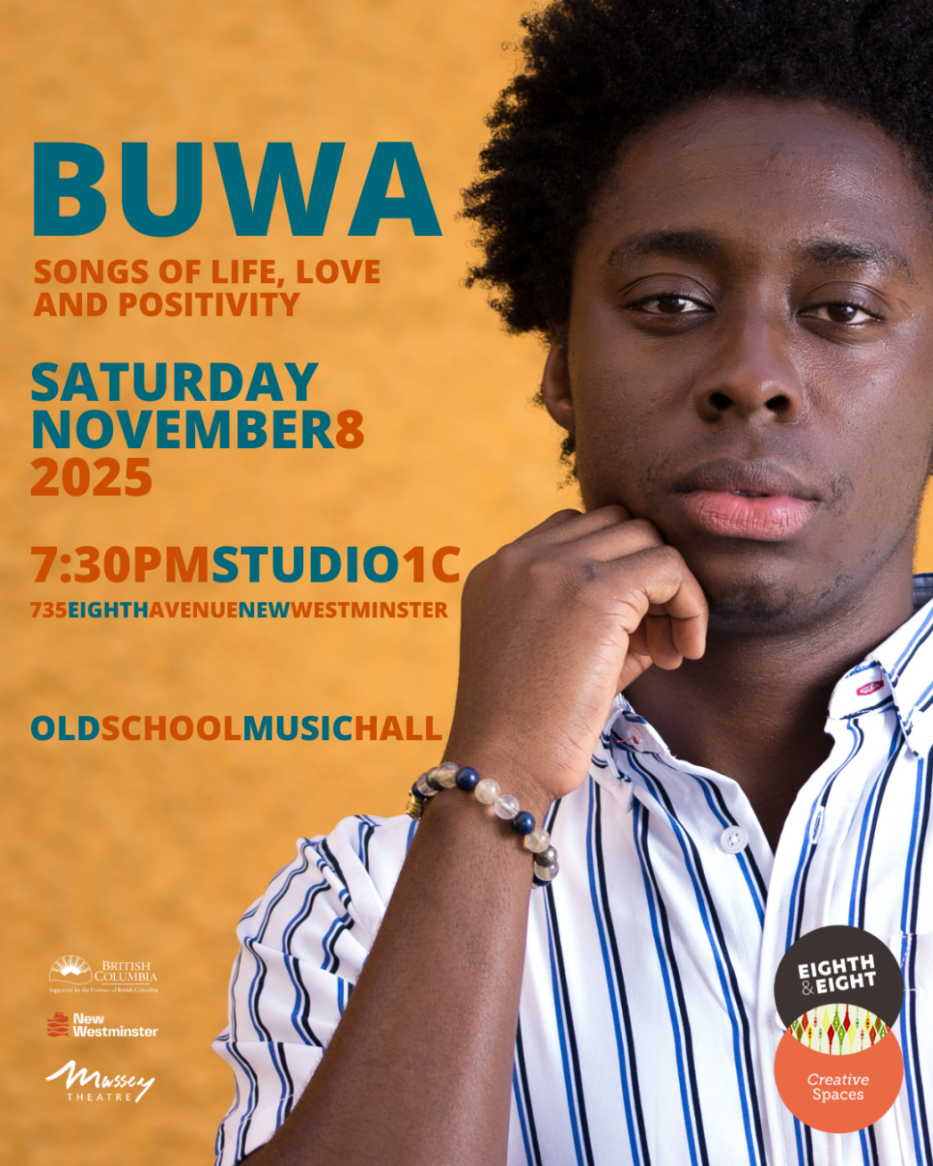
This November 8th at Massey Theatre in New Westminster (yes, we’re crossing the Fraser for this one), and it’s worth the SkyTrain ride ( us fellow Jaysuits are Eco-counciouslly coded after all….amen), something genuinely special is happening at Studio 1C as part of their Old School Music Hall series… an experience that will reminds you why live music still matters in our overly-digitized, playlist-curated world.
Let me introduce you to :
“Buwa“
An R&B/Soul powerhouse; who trades his banking spreadsheets for the stage, fueled by a singular mission: to dismantle the “single story.”

The Soul Detox and the African Story
Yes, you read that right: A CIBC Bank manager who literally uses music as his escape, describing singing as his profound “safe space” and “the only thing that truly gives me joy,” where he is “at peace” and “content“. That’s the energy we’re dealing with; the kind of essential, necessary passion that cannot be contained by a spreadsheet.
This need to sing, this necessity, is what gives his music such serious weight. He’s a contemporary soul artist with pop and R&B sensibilities, carrying a penchant for storytelling. But here’s the key difference between Buwa and many other rising stars: he layers his foundation with the rhythms of home.

Maybe it’s the Kenyan in me, but there’s something about hearing an African artist on Vancouver stages that feels different.
It’s not just representation; though that matters. It’s the specific way Buwa refuses to perform despite his Nigerian roots and instead performs through them, weaving Afrobeats influences (Burna Boy, Wizkid, Tiwa Savage, Yemi Alade) alongside vocal titans like the late Whitney Houston and the courageous, defiant spirit of South African anti-apartheid legend, Brenda Fassie. He layers this foundation with the lyrical depth of Jill Scott and India Arie, the spiritual grounding of gospel legends like the Clark Sisters and Kirk Franklin, and the theatrical, unapologetic flair of Billy Porter.
This specific cultural alchemy results in a voice that is both profoundly rooted and urgently contemporary. A sound that carries Lagos and Nanaimo in the same breath.
His father understood this instinctively, playing Celine Dion and Whitney Houston on repeat; over and over and over—in their Nigerian home, building a foundation where excellence knew no borders. Church choirs from childhood through university refined the technical skill. But it’s the Afrobeats pulse, the rhythms of home, that keep his music tethered to something deeper than technique.
But here’s what the press releases wont tell you: Buwa sings like someone who needs to. Like music isn’t a career choice but a survival mechanism. His safe space. The only thing that truly gives him joy, where his heart is full, where he’s at peace, where he’s content. When he’s singing, he’s home—regardless of which continent he’s standing on.
For me, someone with African roots, I know that fight in my bones. It’s the fight against the assumption that defines a person or a place by what is only visible on the surface; the poverty porn, the “exotic other,” the simplified reductive narrative that erases complexity and humanity. It’s the exhausting work of constantly expanding people’s understanding, of saying “yes, and” to every reductive story someone tries to tell about where you’re from.
And this matters because Buwa’s music is driven by a mandate that hits close to home for anyone who hails from the continent. He is fighting the dangerous “trap” of the “single story,” aiming to fundamentally change the way the world sees Africa; not through politics or preaching, but through infectious melodies and performances that refuse to let you look away.
The Danger of a Single Story
It’s a concept that guides Buwa’s entire life, something he heard when he was 13 or 14 from author Chimamanda Ngozi Adichie in a TED talk, and it’s never left him:
The danger of a single story.

No one is ever a single story. There’s always something beyond what you see, what you know, what you read, what you watch online. We’re all full human beings with full lives, full families, threads that go in ways you have no clue about. It’s part of what’s affecting the world today; we’re all seeing one story about each other. Judging people based on what we see them as on TV or walking down the street, without recognizing there’s more. Always more.
The worst thing you can do, Buwa says, is start someone’s story from the second chapter. Because there’s always something that happened before that. It guides how he lives and talks to people, how he creates. He catches himself sometimes, stops himself from assuming, reminds himself: don’t assume a single story. That’s a person with a whole life.
And maybe that’s why his music hits so hard. Because he’s not giving you a single story. He’s giving you his story; messy, complicated, joyful, painful, Nigerian, Canadian, queer, human. All of it at once. All the threads woven together into something that refuses to be reduced to one simple narrative.
When Buwa sings, you’re getting a whole person, standing in their truth, inviting you to see beyond whatever single story you might have been told about what a soul singer sounds like, what a Nigerian immigrant looks like, what queerness looks like, what love looks like.
Witnessing it firsthand: after one performance in Port Alberni with Joel Rao, an audience member approached him to say that after hearing Buwa’s music, he was going to “protect everybody I know who is black and who is gay.”
From one hour of singing. One hour of standing in truth.
That’s not entertainment, that’s transformation. That’s music cutting across demographics and dismantling prejudices in ways a thousand think-pieces never could. That’s what happens when you refuse the single story and offer up the full, messy, beautiful tapestry instead.
The Safe Space and The Turning Point
Now, I need to talk about Kinky Boots.
Not because I’m trying to sell you on theatre (though if you missed Buwa’s performance as Lola with Qualicum Players, you missed something extraordinary), but because what happened during and after that production tells you everything about the kind of artist—and human—you’ll be experiencing on November 8th.

Kinky Boots is a story about acceptance and recognizing that we all bleed red, regardless of which different lanes we’ve walked. A factory owner meets a drag queen in London, they start making six-inch thigh-high boots to save the business, and through it all, they navigate understanding, bias, and love.
For Buwa, playing Lola was emotionally intense in ways he didn’t fully prepare for, pulling from real experiences, real pain, and real joy. The story mirrored his own life and the lives of people he knows and loves. He describes it as one of the best experiences of his life—and one of the hardest.
It took him a month and a half to let go of that character. A month and a half to process, to heal, to confront things he might never have had the chance to confront otherwise. The show helped him heal in ways he didn’t expect, forcing him to face things head-on.
And here’s the part that gets me: he remembers posting about the show on Instagram for the first time. The moment he made it public. He laid on his bed with goosebumps running through his entire body, literally shaking, thinking about the backlash he might face from his Nigerian community.
A friend called; someone who’d seen the post and just knew, and Buwa admitted he wasn’t okay, that he was trembling and the goosebumps hadn’t gone away.
Growing up in Nigeria, where being gay wasn’t—and still isn’t—easy or accepted, he couldn’t have had this conversation a few years ago. He was scared of what people would think. Even now, he catches himself trying to hide, trying to be careful about what he says and where, worried about backlash from his community. But he’s getting older. And at some point, you have to be true to who you are. He knows some people will never understand, will never accept. He’ll probably lose people he grew up with, people he truly loves, people who loved him and helped him through life—people who might never be able to see beyond this one aspect of who he is.
But the older he gets, the more confident he becomes in standing in his truth. In being who he is. In accepting who he is. It’s a daily struggle, he admits. The way he was brought up, the world he’s closely connected to and loves—it makes authenticity complicated. But he has to be true to himself.And Kinky Boots was a turning point. After that Instagram post, after the shaking and the fear and the waiting for the world to end—nothing happened. People talked. It was fine. He was okay. He’s still here.
“Love is Love” and the Power of Honest Songwriting
Buwa has been writing songs for a long time. Playing with melodies constantly, singing random things in his head, making voice notes and forgetting about them for years before rediscovering them and thinking,
“Oh, that’s kind of nice.”
He writes about his life. About things he truly understands. About experiences he’s been present for. He doesn’t want to talk about things he doesn’t know about—and it shows. You can hear the authenticity in every lyric, every melody choice, every vulnerable moment.
But there’s one song that stands out. One song he calls his favorite to perform, even though he’s still trying to find the right moment to properly record it.
It’s called
“Love is Love.”
Here’s how it came to exist: Buwa was asked to write a song for a concert in Nanaimo a few years ago. He wrote one. They didn’t like it. (Which, honestly, would have pissed me off, but he handled it with more grace than I would have.) So he went back and wrote three more songs.
They chose the one he thought would be the least likely. But looking back now, it makes sense. Because “Love is Love” was the most honest song. The other two he wrote thinking about choirs, about Nanaimo, about the Island, about what would sound good in a specific context. But “Love is Love”? He wrote that one for himself. Maybe he’d sing it one day. Maybe not.
The song is simple in its thesis: love is love. It doesn’t matter if you’re man, woman, Black, white, Asian—love is love. That’s it. That’s the whole radical, beautiful truth. Nico Robo arranged it, and when it was performed, the audience reaction was immediate. Because it’s relatable for everybody. It doesn’t matter who you are—if you love somebody and that person loves you, that’s it. That’s really it.
The Vancouver Gay Men’s Choir has performed it twice, which Buwa describes as a “huge honor.” And he’s right—it is.
From Writer’s Block to “Just Call Me Buwa”

After Olu dropped in 2019, Buwa hit a wall.
COVID happened. And then… nothing. Everything he tried to write felt hard. Forced. Like he was trying to create rather than letting it flow out naturally. Classic writer’s block, but the kind that makes you question everything.
Then one day in 2022, randomly pacing around his house, a melody hit him. “Oh, that’s a nice song.” He stopped mid-pace like someone possessed, singing the thing back and forth, thinking, “This is nice. This is actually nice.”
He grabbed his phone, called his friend immediately: “Hey, I have an idea and it’s here now. So I need to do it now before it leaves. I’m going to give it to you, make some beats, and bring it back to me.”
And just like that, the dam broke. They ended up with seven songs, recorded five for the EP.
But here’s what makes Just Call Me Buwa different from Olu: confidence.
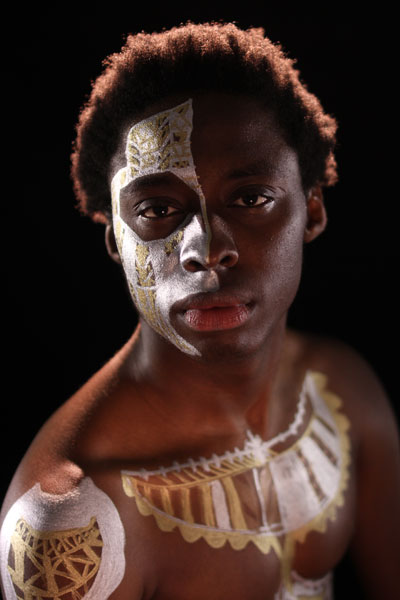
With his first project, if you look at the visuals, Buwa is blurred out in places. Which was fine—it was where he was at that moment. But with Just Call Me Buwa, he took risks. Real risks. There’s makeup. There’s costume. There’s presence. Things he would have been terrified to do before.
The title itself is a declaration: “Hey, this is me. Just call me Buwa. I don’t care.”
Well, that last part might not be entirely true—he admits he still cares sometimes, still has moments of fear and self-consciousness. But he cares less. And that shift, that willingness to be more visible, more himself, more unapologetic? That’s growth you can hear in every track.
Mark Your Calendar (And Charge Your Compass Card)
The fanboy moment has happened. Now comes the part where I actually tell you how to make this experience real. Yes, you have to cross the Fraser River to get to New Westminster. It’s a trek we Vancouverites sometimes dread, but honestly, it’s easier than you think. The trip is short, simple, and the emotional payoff justifies the transit fare entirely.
When the Music Starts:
Friday, November 8th, 2025. Doors at 7:30 PM, with two hours of soul, storytelling, and Afrobeats-infused magic running until 9:30 PM. This is the kind of intimate evening where every note, every story, every vulnerable moment lands exactly where it needs to.
Where Community Gathers:
Studio 1C at Eighth & Eight Creative Spaces, 735 Eighth Avenue, New Westminster, BC V3M 2R2. The Old School Music Hall series exists because some voices deserve to be heard in spaces where community still means something; where music halls were about gathering, connecting, and experiencing artistry that spans continents, from Nigeria to Nanaimo, from gospel choirs to contemporary soul.
The Price of Authenticity:
$24 – $42 for an artist who uses his music to change the way the world sees Africa. For a voice raised on Whitney and Celine, refined in church choirs, and infused with the rhythms of Burna Boy and Wizkid. For an evening that promises to leave you feeling different, changed, empowered, and ready to face whatever comes next.
What to Bring:
Your dancing shoes. Zero preconceptions. Prepare to witness someone who carries Nigeria in his bones and Vancouver Island in his soul, standing fully in his truth, inviting you to do the same.
Find Buwa:
- Website: www.buwa.ca
- Instagram/TikTok/Twitter: @buwalegend
- Facebook/YouTube: Buwa
See you in New Westminster, where authenticity—and a whole lot of soul—lives.
—Jaysus
© 2025 BUWA – ALL RIGHTS RESERVED
Copyright © 2020 Massey Theatre.