
“The Spark in the Rain“
Jaysuits, I have a complicated relationship with the darker months here. I love the excuse to slow down, but I get restless. I start looking for that spark, that pulse of energy that reminds me this city is still alive under the grey. The rain, like clockwork, has settled in across Metro Vancouver; and as we move deeper into November, the city’s cultural rhythm changes. It turns inward. It becomes contemplative.
Walking down Great Northern Way these days feels different. Usually, this stretch acts as a sleek, industrial corridor for the digital elite, a place where various tech HQs hum with quiet, proprietary energy. We often treat this area as a separate ecosystem from the scrappy galleries on the East Side or the elegant theatres downtown. But this week, that separation dissolves.
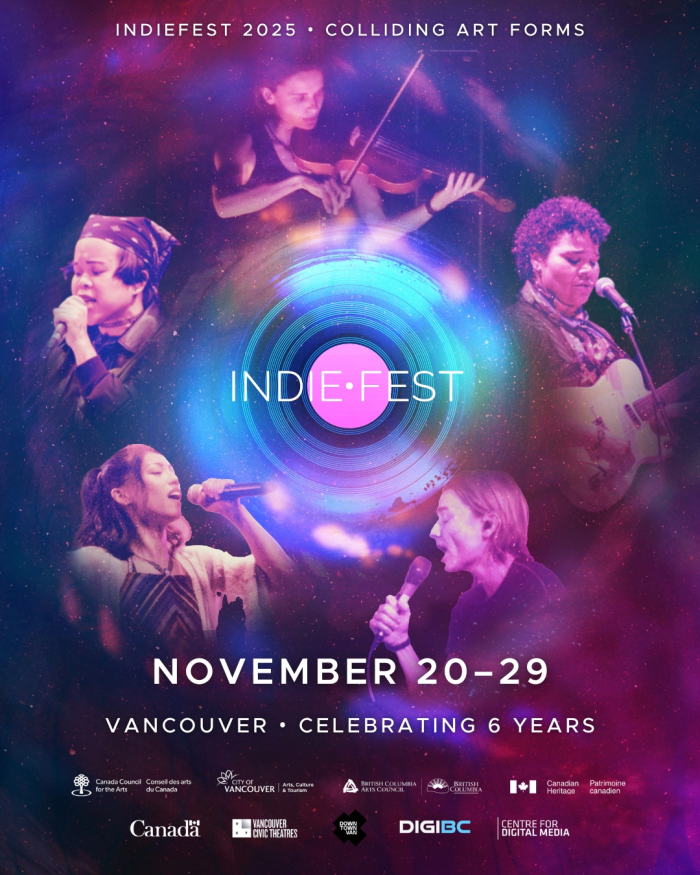
IndieFest has arrived once again, and with it, a profound reshaping of how we view our city’s creative infrastructure. This marks the sixth year of the festival, yet it feels less like an anniversary and more like a necessary evolution. We have tracked the trajectory of re:Naissance closely on this site. We recently experienced their dismantling of operatic tradition in The Queen in Me, where the rigid structures of the past cracked open to reveal raw agency. We explored the digital underworld of Eurydice Fragments in last year’s festival, seeing how extended reality could ghost-hunt through our emotional landscapes. But this year’s theme,
“Colliding Art Forms“
suggests a more urgent agenda.
This week, the DigiBC studio ceases to be just a production facility. It transforms into a junction point. The festival runs from today, November 20, through November 29, occupying multiple venues but anchoring its spirit in this concept of “collision.” We will see the unexpected fusion of archaic storytelling forms with cutting-edge immersion. We will witness artists who usually perform in completely different spheres finding common ground in the digital ether, a festival that reinvigorates traditional storytelling by smashing it together with emerging technologies. It nurtures equity-deserving voices and brings people together across every conceivable medium.
We often see our artistic communities operating in distinct lanes where the theatre crowd stays in the theatre and the tech crowd stays in the tech hubs. Debi Wong, the founding artistic director of re:Naissance, put it perfectly when she said that, “In Vancouver, we often see artistic communities working in silos”. For the performing arts community in Vancouver, survival requires a kind of resourcefulness. We simply cannot afford to exist in silos any longer. The future of storytelling depends on cross-pollination.
I find this fascinating because it mirrors the conversation we had around the Small File Media Festival. There, the constraint was file size to save the planet. Here, the constraint is collaboration to save the art. Debi believes the future of performing arts depends on this kind of collision. She is right. It serves a purpose beyond novelty. It acts as a direct response to the moment we are in. The world shifts rapidly under our feet. Artists possess the unique opportunity to explore how different technologies and perspectives can reshape our experience of storytelling and connection. Think about it. When you bring a coder from into the same room as a traditional opera singer or a hip hop artist, you create a third space. You create an environment where the creative toolkit expands exponentially. This is cultural sustainability in action. It ensures that traditional forms like opera or oral storytelling endure by evolving and by breathing the same air as VR and spatial audio. She speaks of a world shifting rapidly beneath us, suggesting that the collision of disciplines—tech, opera, hip hop, indigenous oral history—serves as a response to the moment we inhabit.
But it is not just about the gadgets. It is about the people. By facilitating these collisions, IndieFest is building bridges between communities who might not otherwise ever be in the same room. It is equity-deserving voices taking up space in the tech world. It is traditional storytellers adopting digital mediums. It is a celebration of the unexpected ways we can connect when we stop staying in our lanes.
Over the next ten days, venues across Vancouver, including the DigiBC Creative Tech Studio are going to transform into laboratories for this experiment. We are talking about a festival that includes everything from a hip hop reimagining of Dante’s Inferno to an immersive sonic ceremony that uses indigenous wisdom to explore consciousness.
It is ambitious. It is messy in the best possible way. And it is exactly the kind of jolt we need to wake us up this November.
I am going to take you through everything happening over the next week and a half. We are going to look at the schedule, break down the must-sees, and figure out how you can get involved. Whether you are here for the tech, the music, or just to support local artists who are swinging for the fences, there is something here that is going to surprise you.
Let’s get into the schedule, starting with where it all kicks off tonight.
The Laboratory of the Now
We start with the most intimate collision of the festival:
Willilish’d
The project comes from the duo As and When, formed by Thule van den Dam and Hayley Sullivan McInerney. They create interdisciplinary work using elements of music, theatre, and design. By juxtaposing live performance and technological manipulation, they engage with how memories are constructed and transformed and how nostalgia for the mundane becomes transcendent.

Hayley Sullivan
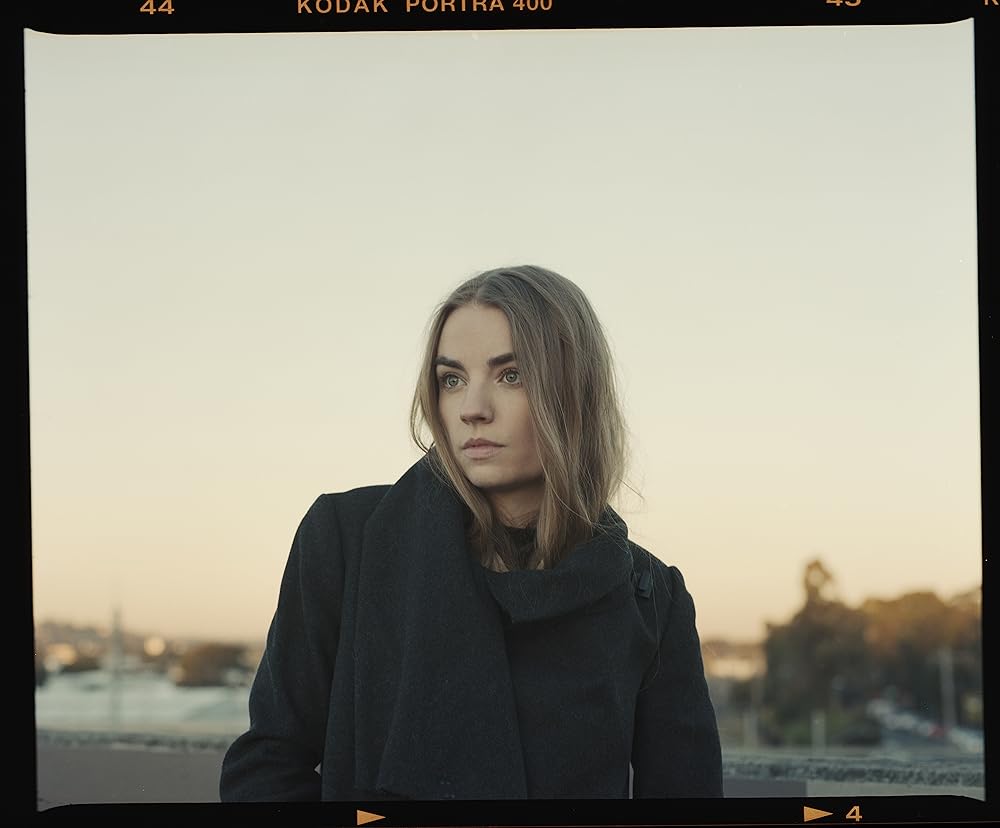
Thule van den Dam

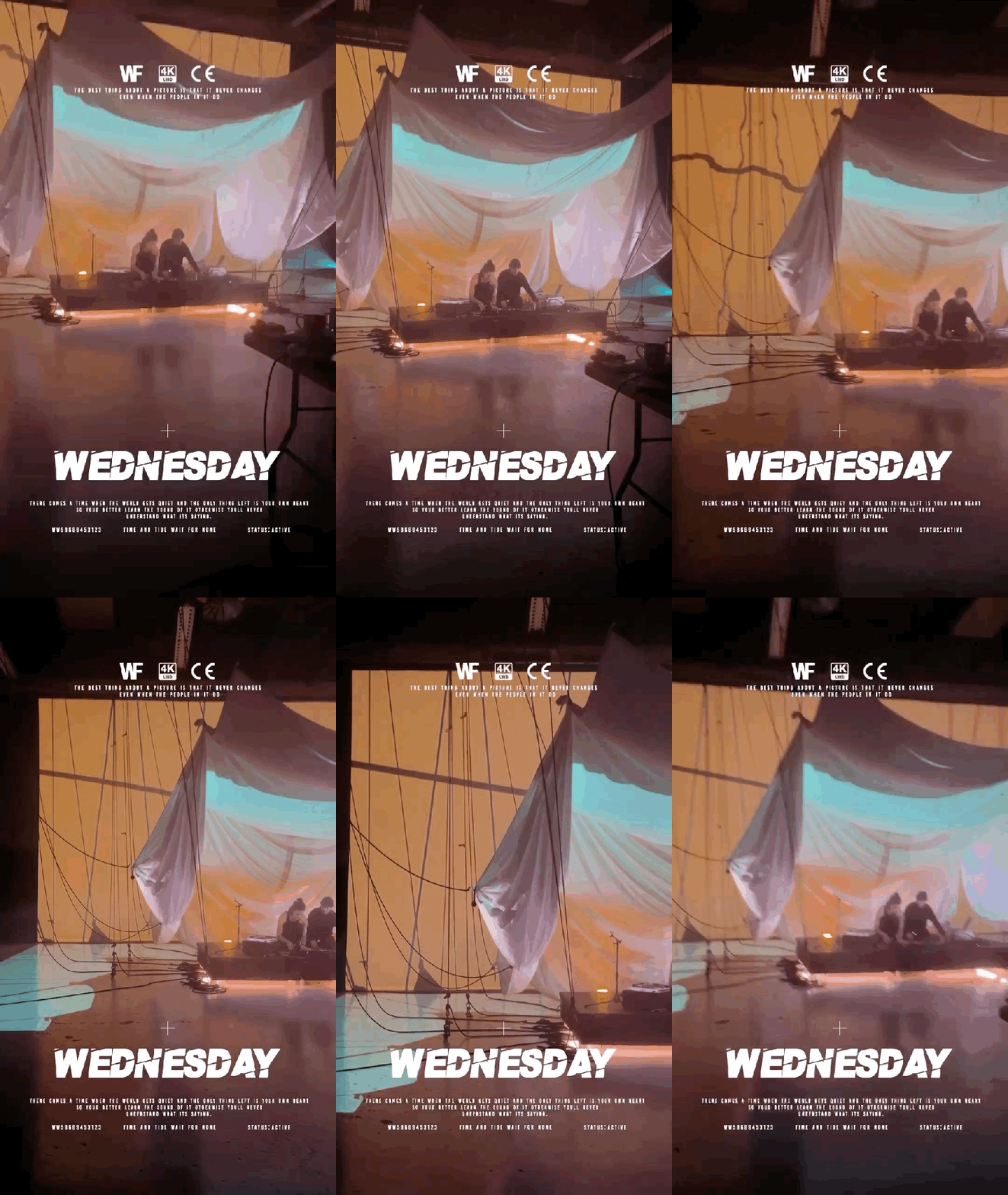
They are doing something fascinating here. Through creative design, quad sound, and archival elements, what was two-dimensional and in the past becomes four-dimensional and present; exploring themes of memory and motherhood through lullabies. If you remember my review of Eurydice Fragments last year, we talked at length about how technology can fracture a narrative to show us different sides of the truth. Willilish’d takes that concept and applies it to something far more personal than Greek myth. It applies it to the relationship between a mother and a daughter. Now, you might think of lullabies as simple or old-fashioned. But that is exactly where the “collision” happens.
It is about taking a small, sustainable resource—a human voice, a hummed melody—and using various technologies to expand it into something massive. By taking these fragile, organic nursery rhymes and feeding them through loop pedals. If you have ever played with a loop pedal, you know how it works. You lay down a track. You record over it. You add another layer. Eventually, the original sound gets buried, distorted, or transformed into something completely new. It is a perfect sonic metaphor for how we remember our childhoods. We think we have the clear picture, but we are really just listening to a loop of a loop of a memory.
Thule mentioned that the loop pedals allow them to “actively construct and deconstruct” the melodies right in front of us. You see every step. You hear the repetition mimic the way we learn as children and the way we manipulate memories as adults. They acknowledge that conversations with our parents are precious and bittersweet. By integrating actual recordings of Hayley’s mother into the soundscape, the conversation stays alive.
I love the backstory here because it grounds the high-concept tech in real human humor. The title actually comes from a nursery rhyme that Hayley’s mother, Glad, claimed she and her sisters invented. It turns out that versions of it exist in poetry across Ireland and Scotland. That discovery creates such a beautiful tension and shows us how oral history gets passed down the maternal line and changes along the way.
There is also a hilarious practical element to this collaboration.
Apparently. Hayley had to make a solemn pledge to her mother back in Australia before putting this show together and her mom was terrified about one specific thing. She worried she would be swearing in front of the audience. So Hayley promised to leave the swearing out of the recordings.
It is such a small, specific detail, but it anchors the whole high-concept performance in the messy reality of family dynamics, these little human details that make the tech feel warm rather than cold.
For me, this is the perfect entry point for the festival. It embodies the “Colliding Art Forms” theme by proving that technology does not need to be alienating. In fact, when you use it like this, it acts as a magnifying glass for our most human connections.
Beyond the Loop: A Roadmap to the Collisions
We move from the personal memory of a mother and daughter into the collective memory of our culture. The scope widens. The collisions become more volatile. I want to guide you through the rest of the itinerary and we’ll see how re:Naissance uses these disparate events to build a complete ecosystem of innovation.
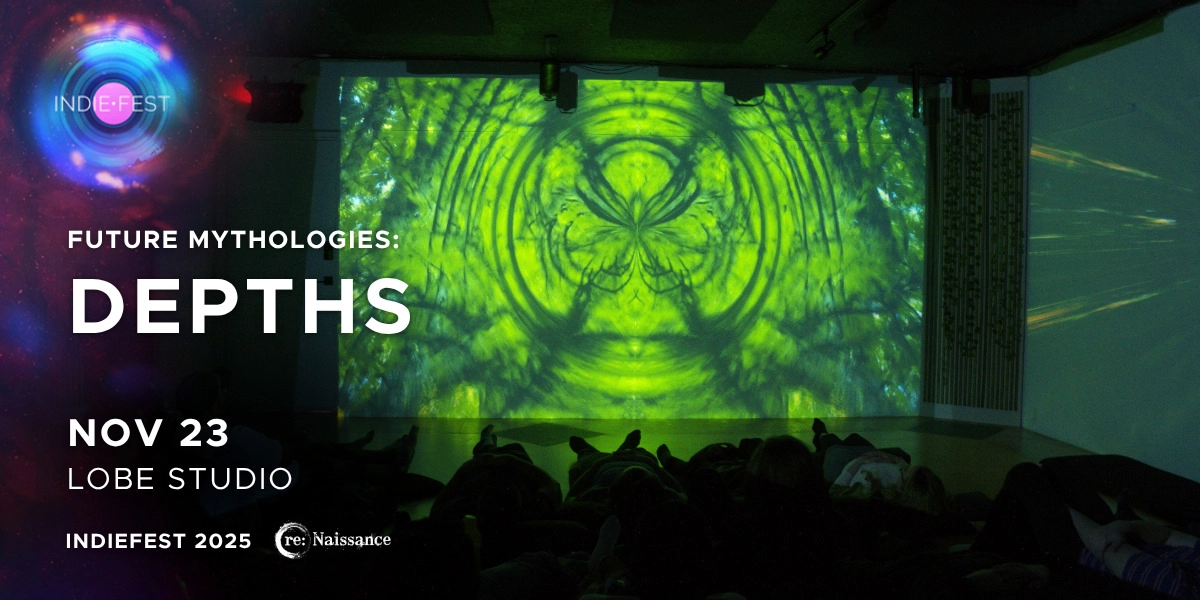
We talk a lot about sustainability in the physical world. This experience focuses on internal sustainability. You enter the Lobe Studio for a 4D spatial audio journey that fuses advanced tech with Indigenous wisdom. It features authentic Shipibo Icaros and binaural beats to guide you through “shadow work” toward transcendence, operating as a sonic ceremony rather than a simple listening party.
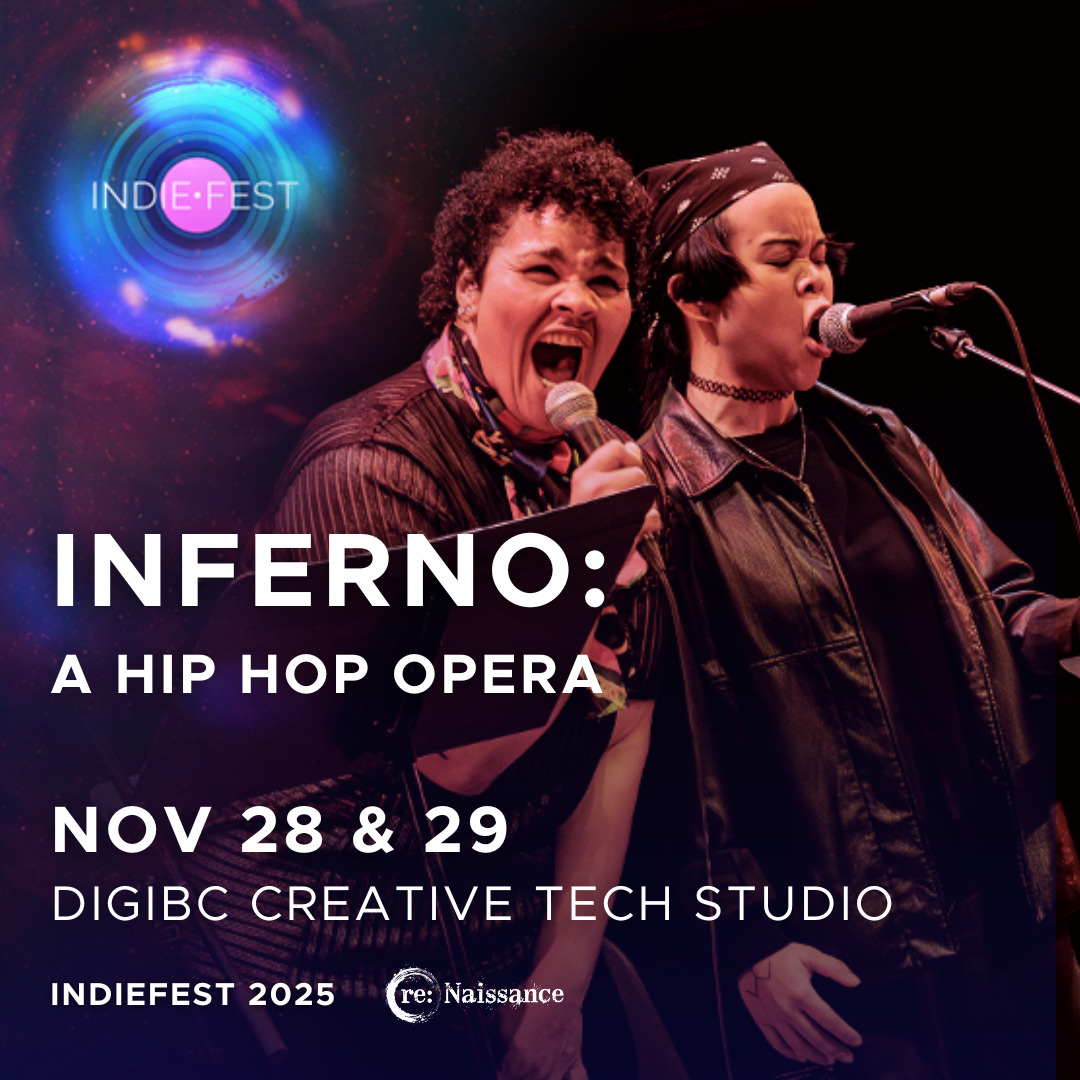
It reimagines Dante’s Inferno as a feminist, anti-colonial allegory where Hell is a Spotify-esque corporate headquarters. The protagonists have to fight the CEO (the Devil) to take back ownership of their music. It blends beatboxing, rap, and R&B with contemporary opera to celebrate IBPOC voices in a way that feels totally fresh.
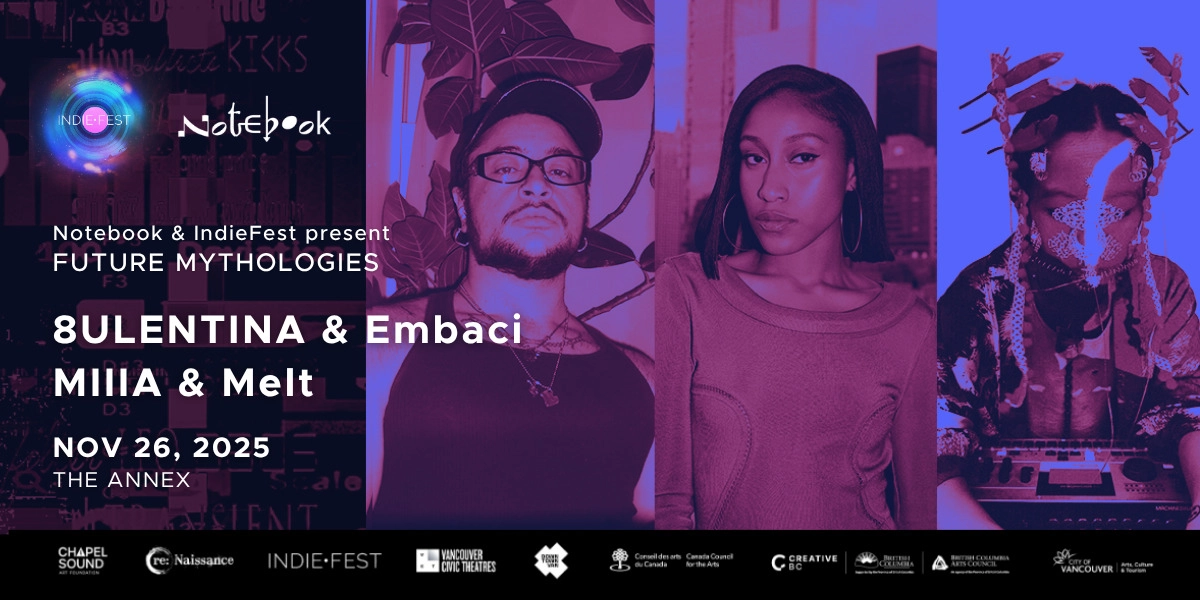
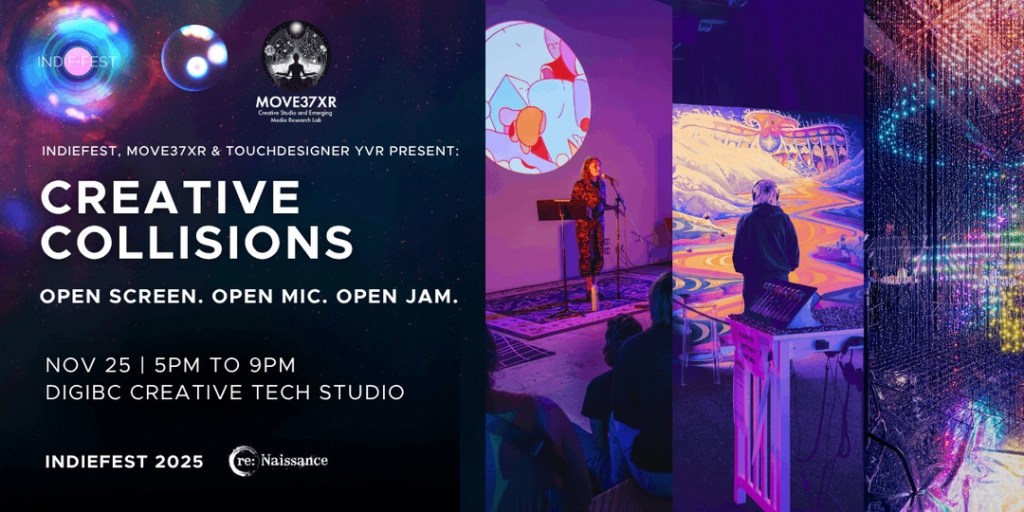
Vancouver’s first-ever Immersive Jam Session—a night where technologists, performers, and digital dreamers collide to create new worlds in real time. Explore four interactive showcase zones, including the Immersive Stage (wall and floor projections), Voxelite (20,000 LED Light Sculpture), 270 Projection Cube, and the 20’x20’ Floor-to-Ceiling Lounge Screen, as artists share works-in-progress, experiments, and spontaneous performances.
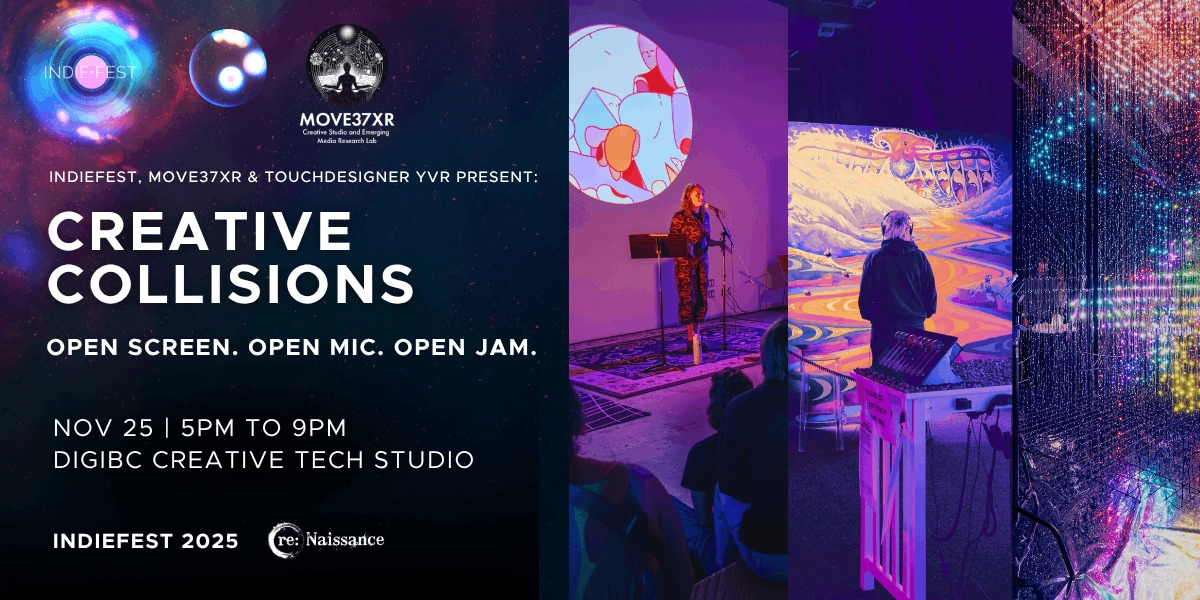
This showcase features a collaboration with Notebook and Chapel Sound to explore the intersection of electronic music and folklore.
The Sanctuary at Lobe
Now, this is where the festival stops being a show and starts being a necessity.

Show 1 Doors 6pm | Show 6:30pm + Artist Talk
Runtime : 1 hr
Show 2 Doors 7:30pm | Show 8pm + Artist Talk
You might know Lobe as the place with the fancy 4DSOUND system, the only permanently integrated one in North America. And yes, the tech is incredible. The speakers are everywhere—in the ceiling, under the floor—creating a holographic sound environment that moves through you like a ghost. But focusing on the specs misses the point entirely.
From its inception,the studio has operated with a mandate that hits me in the chest:
The destigmatization and accessibility of mental health.
Think about where they are located. East Hastings. It’s not a random choice. They are planting a flag for wellness in a community that is constantly reduced to a single, tragic narrative. They are using this multimillion-dollar technology to create a profound “safe space” for regulation and healing. Science tells us that spatial sound immersion works; it actually assists in cognitive-behavioral therapies and somatic healing. It creates a container where your nervous system can finally exhale.
Jaysuits, understand what you are walking into. It is a “sonic ceremony” that collides high-tech audio with Indigenous wisdom and authentic Shipibo Icaros. A refusal to separate the spiritual from the technical. For me, it feels like a survival mechanism. In an era that demands we constantly grind, entering a dark room to be bathed in sound that connects you to the earth is a radical act. It is the only place where the noise of the “exotic other” or the “model minority” falls away, and you are just a body vibrating in space.
The Chaos of the Jam
Monday nights in this city are usually dead, reserved for recovery,rain and peronally for me the $5.99 Dosas on Kingsway (yup, insane deal, especially given the prices these days….), but re:Naissance, alongside TDYVR and MOVE37XR, is turning the DigiBC studio into a living laboratory.
Starts: 5:00 PM PST
Ends: 9:00 PM PST
This marks Vancouver’s first-ever Immersive Jam Session, and the energy here feels distinct from the polished productions of the weekend. It represents a raw, unscripted collision where technologists, performers, and digital dreamers meet to build new worlds in real time.
The space itself is divided into four interactive showcase zones, each acting as a playground for experimentation. You have the Immersive Stage, where wall and floor projections allow you to physically step inside the narrative. There is the 270 Projection Cube, which surrounds you completely, breaking the separation between the observer and the art. You can lose yourself in the massive 20’x20’ Floor-to-Ceiling Lounge Screen, a scale that makes digital art feel architectural.
Yet, the pulse of the room centers on Voxelite. This sculpture isn’t a static piece of decor; it is a reactive organism made of 20,000 LED lights. Inspired by the musical game RIFT, it breathes and pulses in response to sound and movement. Seeing a musician riff on a saxophone while a digital artist manipulates 20,000 lights to match that rhythm in the moment creates a kind of alchemy you simply cannot rehearse.
Throughout the evening, artists will share works-in-progress and spontaneous experiments. This matters because we rarely get to see the messy, dangerous middle part of the creative process; we usually only see the shiny final product. Here, the failures and the glitches are part of the show.
As night falls, the energy shifts into a curated Open Mic & Open Screen. This serves as the climax of the experiment. Musicians, theatre-makers, and digital artists step up to improvise together, merging their crafts into something entirely new. You might hear a beatboxer laying down a rhythm while a coder live-scripts visual chaos on the wall behind them. It is the ultimate rejection of the “silo” mentality. For five dollars, you get to witness the survival mechanism of our creative community in action: people from different worlds finding a common language through noise, light, and sweat.
The Riot on the Top Floor
And then, we arrive at the finale. If the earlier works in the festival focused on healing and memory, Inferno focuses on the fight.
Two Performances:
Friday, Nov 28 | 7:30PM
Saturday, Nov 29 | 7:30PM
Doors open at 7:00PM.
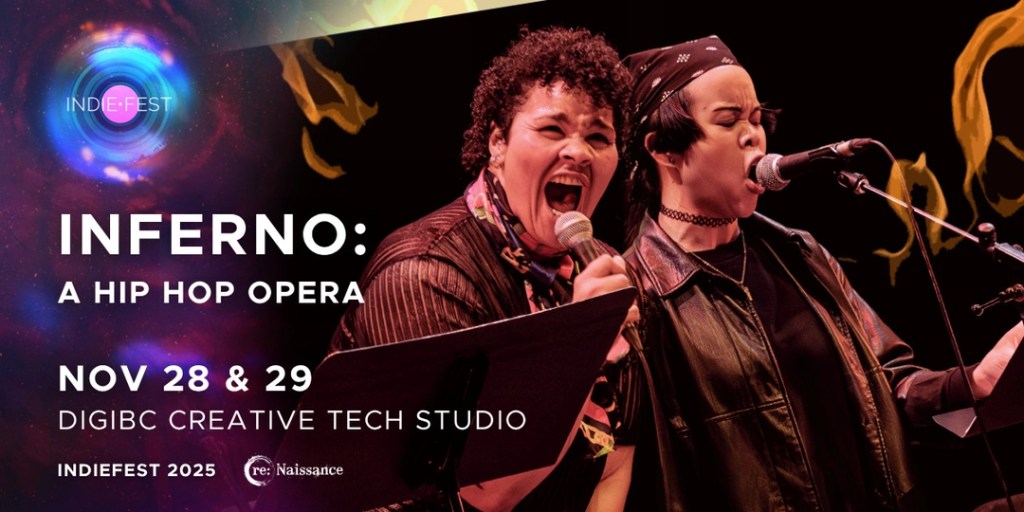
Vancouverites will witness the next evolution of this massive work in development. Written by Omari Newton and Amy Lee Lavoie, the project reimagines Dante’s Inferno as a furious, anti-colonial allegory set in a skyscraper that functions like a Spotify-esque corporate headquarters. In this vision, Hell is not fire and brimstone; it is an algorithm. The Devil is the CEO. The sinners are the artists who have had their culture stolen, co-opted, and monetized by a system designed to erase them.
The casting here represents a specific kind of power, anchored by a performer whose previous work has fundamentally reshaped how we view the operatic stage. Teiya Kasahara returns to IndieFest, and their presence carries the weight of history. Us Jaysuits know them from The Queen in Me, a production that garnered five Dora Mavor Moore Award nominations for the way it breathed new life into Mozart’s iconic Queen of the Night. Kasahara took a character historically vilified as a “battle-axe” and dismantled the patriarchal narrative that confined her. Now, that same spirit of reclamation fuels this new battlefield.
But Kasahara is not fighting alone. The production surrounds them with a squad of disruptors who each bring their own history of resistance to the microphone.
You have Kimmortal, an artist known for a signature “subversive gusto” that flows effortlessly between singing and rapping. If you caught their work on HBO’s Sort Of—which won a Canadian Screen Award for Best Original Song—or heard their anthem “This Dyke” on The L Word: Generation Q, you understand the energy they bring. Kimmortal moves with a human vulnerability that disarms you before hitting you with lyrics that dissect intergenerational trauma and celebrate the 2SLGBTQ+ community. Seeing that raw, pop-layered hip hop energy collide with the structure of an opera promises to be electric.
Then there is Leo D.E. Johnson, a trans, Black, Scotian artist who grounds the piece in something ancient and urgent. Known for his work with the duo Old Soul Rebel, Leo blends “Galactic Gospel” with gritty rock influences. He uses his voice to advocate for Indigenous, Black, and Queer communities, promoting themes of resilience and self-discovery. In a story about fighting a corporate devil, having a vocalist who specializes in spiritual soul feels necessary. He brings the spirit of the resistance.
Finally, constructing the sonic architecture of this world is Scribbly Doodle. This man operates as a former World Beatbox Championship competitor who treats the microphone like a construction site. While his solo guitar work is melodic and intricate, his beatboxing is where he builds full-band soundscapes from scratch. Blending folk, blues, and electronic influences to create music that feels immersive and playful and building the very floors of the skyscraper that the characters must ascend.
Together, this quartet tells the story of Vie, a young producer, and Mo, the building’s security guard. Both characters carry the scars of an industry that consumes creativity without feeding the creator. Their journey is not a descent but an ascent. They must fight their way up through the layers of this corporate hell to reach the penthouse. This concert performance strips away the spectacle to focus on the raw power of the text and the sound. It acts as a celebration of IBPOC voices asserting their right to exist on their own terms. They are not asking for a seat at the table. They are coming to take the whole building.
So here lies the reality. You can stay home this November. You can stick to the spreadsheet of your life and wait for the sun to come back.
Or you can go to Great Northern Way and see what happens when artists stop asking for permission and start building their own worlds. IndieFest surpasses being “cool tech” or “innovative theatre.” It acts as a necessary collision. It is the sound of a community finding its voice in the static.
I will see you there.
IndieFest 2025 is supported by the City of Vancouver, BC Arts Council, DigiBC, Vancouver Civic Theatres, and the Province of British Columbia. They gratefully acknowledge the support of Canada Council and are funded by the Government of Canada – Financé par le Gouvernement du Canada.