


Jay Shah
DevOps\Aerospace Engineer & Journalist
“What happens when the past isn’t just remembered, but reassembled around you?”


Jaysuits, some works of art transport you. Others unsettle you. And then there are those rare works that feel like a portal; not to another place, but to worlds of Persian memories and myths, ancient pasts and present.
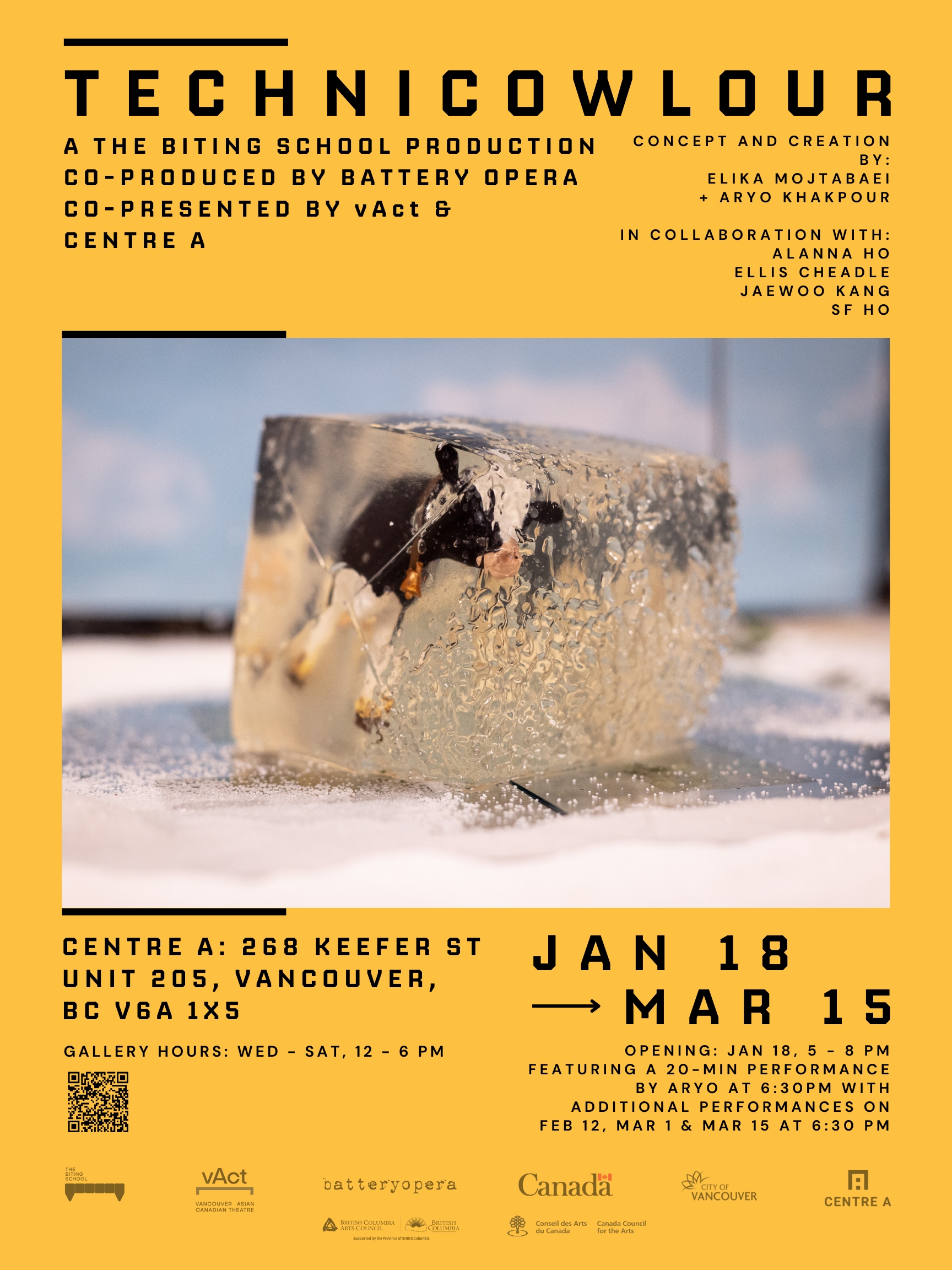
“TechniCowlour“
is exactly that

Created by my friend and Vancouver‘s renaissance man (performer,director,dramaturg,kind person etc etc, phew); Aryo Khakpour along with his equally talented wife Elika Mojtabaei, collaborators Alanna Ho, Ellis cheadle,Jaewoo Kang, SF Ho. This Biting School production is anything but conventional. It takes inspiration from The Cow (1969); a seminal Iranian film about grief & identity and morphs it into something deeply personal and unapologetically experimental.
With TechniCowlour, they push even further; queering and remixing materials & mythologies into something hauntingly beautiful. We step into a dreamscape where past and present bleed into each other, where second-hand fabrics tell ancient stories, where darkness is filled with whispers of scent and sound, and where an oasis becomes a fragile anchor in the vast sea of displacement.
But before we get too carried away, let’s break this experience down, Jaysuits.
What exactly is TechniCowlour?
What does it mean to exist between worlds?
And how does this installation challenge how we think about memory, migration, and cultural preservation?
First, to understand this odyssey is to understand the creative minds behind it all.
This isn’t my first encounter with Aryo, Elika and their various avant guarde collaborators’; or to an extent even the persian adobe architecture exhibit that I covered last year. Jaysuits will remember my plunge into Empty-Handed a few months back, his brother Arash Khakpour‘s gripping Biting school production that dismantled narratives of loss and exile through visceral, raw performances.
His contribution to the SMALL FILE MEDIA FESTIVAL
Or perhaps you caught my coverage of GAME PROJECT, where Aryo was the unseen force behind the lens, weaving an urban wander through hidden Vancouver stories. And then there was my first meeting with him and his wife, at the Polygon Gallery, where I witnessed their surrealist vision firsthand. Each time, their work has been a layered, thought-provoking experience, demanding both intense presence and reflection.


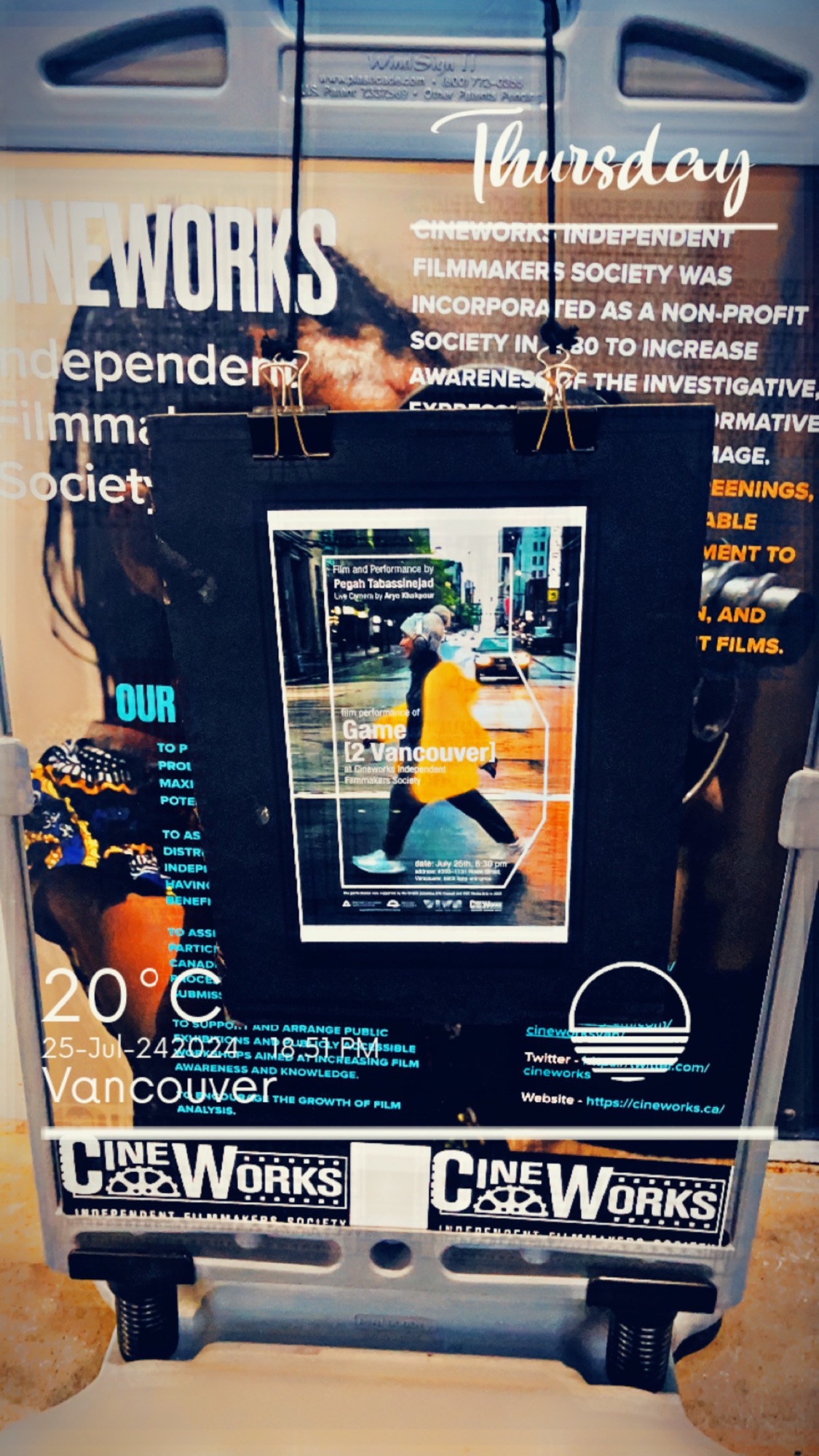
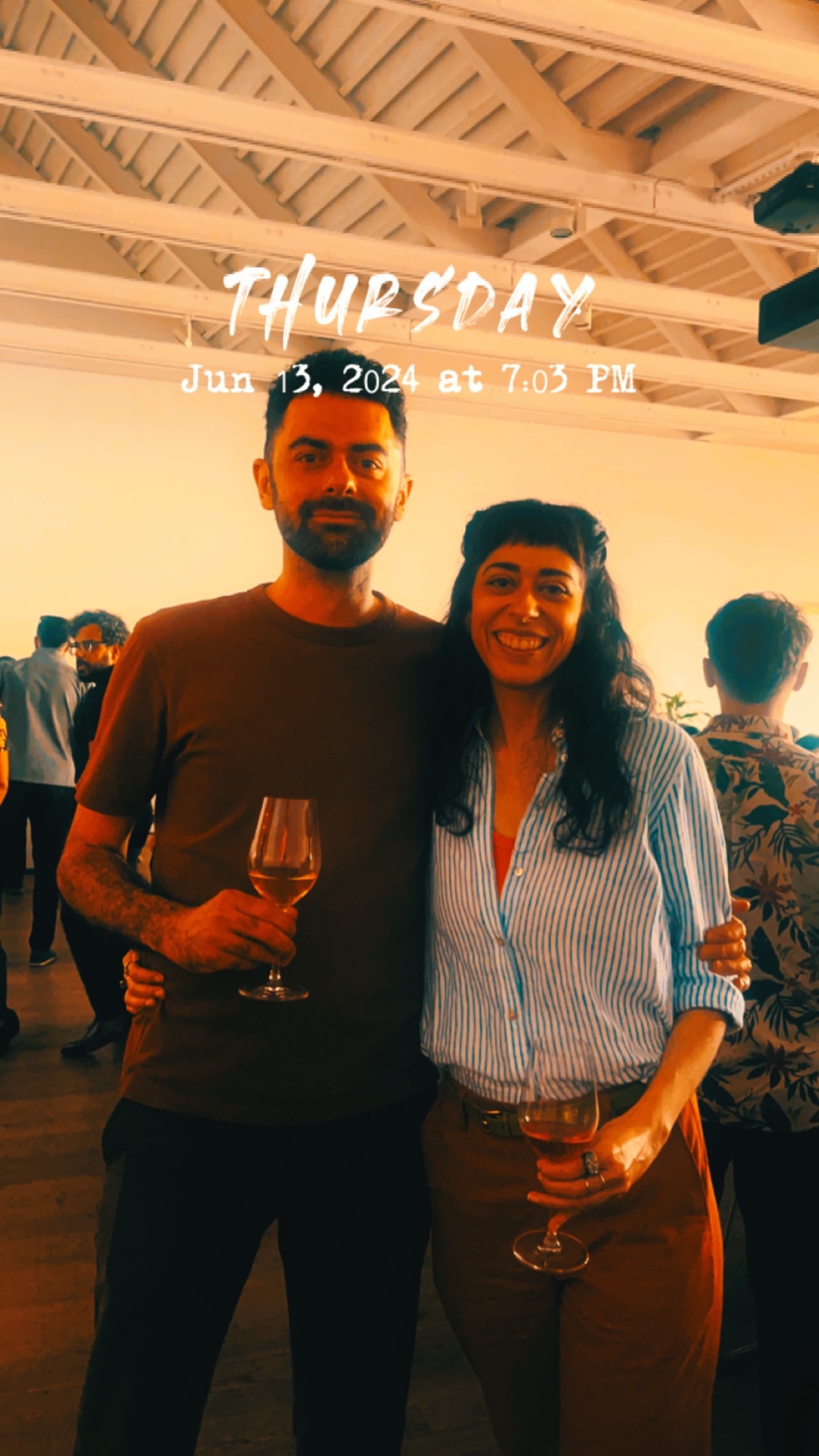


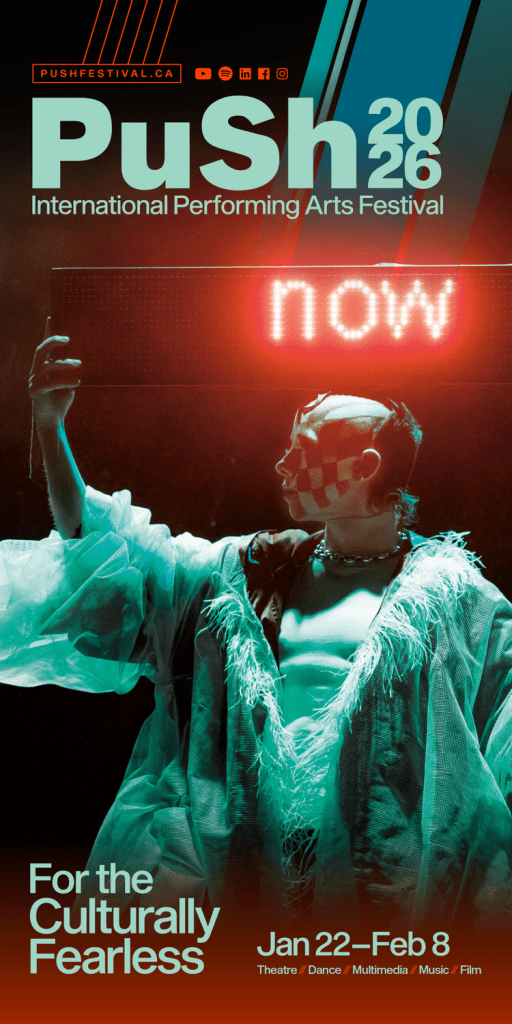
And now, there’s another layer to add to this unfolding story. Aryo was a company-in-residence at the PuSh Festival; the very festival we recently covered! PuSh has been a beacon for genre bending performances in Vancouver, and it’s no surprise that Aryo, with his fearless approach to storytelling, found a home there. From large scale theatre works to intimate, multi-sensory installations like TechniCowlour and Empty-Handed, Aryo and his collaborators have continually redefined what it means to create immersive, emotionally charged art.
Let’s step into the myth together.
🌀
🐄Udderly Inspired: From Myth to Moo-sic 🐄
How do we carry culture when we no longer inhabit its place of origin?
What does it mean to live between worlds, tethered to histories that both ground and haunt us?
Can longing itself become a form of preservation?
TechniCowlour resists easy nostalgia. Instead, it embraces displacement as a generative force, an artistic act of reclamation and reimagining. As I mentioned earlier, the project takes inspiration from The Cow (Gāv, 1969), a kino that tells the tragic tale of a man so deeply attached to his beloved cow that, upon her death, his grief consumes him, leading him to believe he has become the very creature he mourns. This haunting narrative serves as the emotional spine, becoming a way of exploring identity; both physically and metaphysically.
Where the film’s protagonist succumbs to a singular loss, this work expands that grief into a multi-layered dialogue. Juggling betwwen between ancient past and present, mythology and lived experience; by drawing from pre Zoroastrian deities, reinterpreting them through the language of contemporary installation and performance.
The result?
A sensory driven journey that refuses linear storytelling, much like the fragmented nature of diasporic identity itself.
The Installation: Stepping Into a Living Archive
Jaysuits,some installations you admire from a distance. Others? They drag you into their world, wrap around you, seep into your skin, and refuse to let go.
TechniCowlour?
Yeah, it’s the latter.
A fragmented sensory map of displacement as you’ll see below. It’s a living, shifting environment, and to fully experience it, you need to understand how its spaces breathe and unfold. Think of it as an architectural dreamscape

🔥 The Outer Quarter: A Portal Into the Unknown🔥
Step into the Outer Quarter; the entry point into this world, and immediately, the boundaries between past and present start to dissolve. This space is dark and somewhat disorienting, stripped of excess, forcing you to rely on senses beyond sight. Scents guide you, touch grounds you, echoes fill the gaps. Here, presence and absence become interchangeable, setting the tone for what’s to come
💦 The Courtyard, Barn,and Living Room : Where Water Holds Time🌊
If the Outer Quarter evokes absence through darkness, then this is the space where I feel TechniCowlour fully comes into focus. Where mythology collides with materiality, and where Aryo’s performance later on; stitches the scattered pieces of this world together.
Unlike the darkness of the first room, this space feels open, yet something about it remains unsettled. It carries the weight of displacement, of things that should belong but don’t, of objects that have been moved too many times to still hold their original purpose.
At the center of the courtyard, a small, raised square structure holds water, resembling an oasis of sorts. Water, in so many mythologies, is a site of transition. It does not return to what once was. It only moves forward, shaping and reshaping the landscape as it goes. A symbol of both cleansing and displacement; it washes away the past, but it also holds it. Within this installation, it’s an anchor mirroring the idea that diasporic identity is never static but constantly evolving,ever changing.
At each corner, a potted plant stands watch,like sentinels, guarding the liminal threshold between worlds. Framing the water like an ancient Persian oasis; an offering of respite amidst the turbulence of displacement. In a traditional persaian desert landscape, this remnant of an oasis becomes a portal, a lifeline in an arid expanse, a carefully preserved resource that dictates survival. Here, however, I believe it isn’t just about survival; it’s creating sanctuaries. A sanctuary of another kind, a fragment of something lost yet persistently present. Places where the past could be carried forward.
Like the wind towers in Persian adobe houses , which silently collect and channel air, this space seems to gather the echoes of the past, filtering them into the present moment.
Beyond the oasis, objects carry their own quiet histories. A single chair, placed deliberately, waits in one corner of the living room. Beside it, an old rotary telephone, its presence as haunting as it is mundane. In a world where memory is fragile and disjointed, a phone call might be a lifeline, an attempt to connect across time, across distance.
And yet, the phone does not ring at first. It waits, like everything else in this space, for the right moment. It sits in the quiet, untouched. It hums with an unspoken presence, as if any moment, it might ring, bridging the impossible gap between past and present.
The phone remains silent.
For now.
But when it rings, will someone answer?
Nothing here is whole, and yet everything is connected. Stitched together like a second-hand garment, trembling with the weight of the lives it once adorned. And then, there is movement. A figure steps in and out of sight, lingering between the Courtyard and Living Room, adjusting, observing. The performance has not yet begun, but its presence is already felt. A body navigating an in-between space, a living embodiment of this installations’ themes of fragmentation and transition. But for now, Jaysuits, we leave that thread hanging; the unanswered call, the rippling water, the unclaimed chair.
This isn’t a space designed for comfort. It is a landscape that remembers. A courtyard where the past lingers, a barn that holds echoes of something lost, a living room where time feels hesitant, uncertain of whether to move forward or repeat itself.
How do we carry history when we can no longer inhabit its original form? How do we build sanctuaries when home is no longer one fixed place?
Every flicker of light, every texture, every lingering scent, and every ripple in the water asks these questions.
The answer?
Perhaps it waits in the next room….
🏺 Inner Quarter:Echoes from an Older World 🏺
Past the flickering distortions of water, past the echoes of old telephones, lies the Inner Quarter. This is where myth is reconstructed, where the past is no longer something distant, but something that drapes itself across the body, stitched together from remnants of forgotten lives.
Before Zoroastrianism reshaped the spiritual landscape of ancient Persia, a pantheon of deities thrived; interwoven with the rhythms of nature and fertility. These beings did not conform to strict binaries of good and evil but instead embodied the paradoxes of light and shadow, permanence and change.
Their presence still lingers, not in the rigid structures of dogma, but in the whispered echoes of myth, in the artifacts and rituals carried across generations, and in works like this, which resurrect and reimagine the sacred through contemporary expression.
Some of the deities that might be evoked in this space include:
🔥 Anahita – The goddess of water, fertility, and wisdom, often depicted as a celestial figure draped in starry robes. Revered long before Zoroastrianism’s strict dualism of good and evil took hold, she was a powerful symbol of both nurturing and destruction.
🌿 Mithra – A god of covenants, light, and the sun, Mithra played a crucial role in early Persian spirituality. His cult spread as far as Rome, influencing later mystery religions. The duality of light and shadow in this space could allude to his role as an intermediary between cosmic forces.
🌪️ Vayu – A god of the wind, often considered a force of transition and change, Vayu existed in a liminal space between creation and chaos. The ephemeral, fleeting nature of TechniCowlour—where installations shift, fade, and dissolve—mirrors the restless energy of this deity.
And yet, as I stepped into this space;where light was bound to absence, where deities were stitched from discarded fabrics, where the past felt unfinished rather than distant;something stirred in me. A recognition, perhaps, of another world I once knew.
Though I no longer identify with Jainism, I was raised in its philosophies as a child. And in this dimly lit room, something about the way presence and void coexisted, about the way history was made tangible through repurposed clothes and mythological fragments, reminded me of that early exposure to stories of Tirthankaras (spiritual pathfinders, very similar to Guatama Buddha), and the cyclical nature of existence.

Jainism, much like these pre-Zoroastrian traditions, does not frame divinity as an omnipotent force governing the world, but rather as a state of being; a realization, a transcendence, an eternal cycle of birth, rebirth, and release. And just as Jain temples and art house intricately carved figures of liberated souls (siddhas) meditating in infinite stillness, this space felt like a shrine of motion and memory, where deities were not fixed in place but reconstructed through fabric and time itself.


The costumes created from second-hand clothing act as contemporary relics, blending the sacred with the discarded, challenging the notion of history as something static, instead presenting it as something alive and adaptable. This choice I believe is significant; it reflects the fragmented ways in which diasporic communities preserve and wear their histories, quite literally carrying the past on their backs.
Therefore, in essence, this space becomes an altar to the forgotten; reconstructing how lost deities through modern materials, can help individuals and communities reconstruct their sacred past to inform their present identities.
Ring! Ring!
📞 A Call from the Past, the Present, or Nowhere at All? Aryo’s Performance in the Water Room 💧
At the far corner of the courtyard sits a chair and an old-school telephone.
At first, the living room seems deceptively simple: a chair, an old-school telephone, and Aryo, navigating the in-between.
Then, the ringing begins.
It rings. Then rings again. Its shrill, mechanical tone slices through the stillness of the space. The room is hushed, expectant. A phone ringing usually signals urgency;a call waiting to be answered, an action to be taken. But here, the call remains unanswered. The longer it rings, the more oppressive it becomes, filling the air with a growing tension.
Its mechanical chime pierces the stillness, a sound so mundane and familiar yet suddenly weighty, almost oppressive. A phone ringing demands response. It signals urgency. It begs for an answer. But here, in this fragmented world of myth and memory, the call is left unanswered.
And Aryo moves.
Aryo moves deliberately , he adjusts his posture, shifts his stance, recalibrates his presence. His movements are careful, almost as if he is measuring the space between himself and the audience, between himself and the ringing. He circles the chair, sits, hovers, contorts; a body caught between action and inaction.
Then, without warning, he steps into the crowd.
Not forcefully. Not theatrically. But with an almost awkward hesitancy that makes his presence feel even more intrusive. He weaves through us, standing too close, lingering just a little too long. The audience stiffens. The usual invisible boundary between performer and spectator dissolves, and suddenly, we are no longer passive observers but complicit participants in this moment of discomfort.
At one point, he stands next to me. Close enough that I feel his breath, his quiet presence pressing against the space between us. The air shifts.
Do I react?
Do I look back?
The boundaries blur. In this moment, I am not watching him; I am with him.
Then, he vanishes.
Just like that, he slips into the pre-Zoroastrian room. Gone. Swallowed by light and absence, as if retreating into history itself. The phone continues to ring. The moment stretches. Then, suddenly; he’s back. Emerging once again into the courtyard, as if reassembling himself, reclaiming his place in the present.
It’s a loop. A cycle. A limbo of coming and going, of appearing and dissolving, of presence and absence.
And the phone keeps ringing.
What does it mean to ignore the call?
What happens when we disappear into history and return changed?
What do we do when the past, the present, and the unknown demand our attention?
Aryo never picks up the phone.
And in that choice, a world of meaning unfolds. Does he refuse? Is he afraid? Or is it simply not his call to answer?
The ringing fades, but its echo lingers. And as I step away from the space, I realize; this sound, this tension, this question, will follow me long after I leave and this is something you yourself have to experience individually.
Because some calls, Jaysuits, are meant to be answered personally.
How will your body remember it?
🎟️Moo-ve Fast! Tickets Are Grazing Away! 🎟️
Aryo will perform this special 20-minute piece at 6:30 PM. Tickets for these performances are available on a sliding scale of just $10, $20, or $30, allowing you to choose the level of support that Jaysuits you.
📅 Key Dates:
- Exhibition runs January 18th to March 15th, 2025
- Performance shows: Feb 12th, March 1st, and Mar 15th (closing)
📍 Location:
Centre A (205-268 Keefer Street)
For more updates and to follow my adventures, connect with me on:

Choose an amount
Or enter a custom amount


© 2025 Centre A. All Rights Reserved.
© 2019 vAct.
@ 2024 The Biting School